
Automatic Bomb Calorimeter
Isoperibol oxygen-bomb calorimeter with automatic oxygen filling, lifting and jacket control. ≤11 min fast mode, RSD ≤0.15 %.
- ≤11 min per test (fast mode), ≤16 min classic mode
- Automatic oxygen filling, lifting and jacket cooling
- Temperature resolution 0.0001 °C, precision RSD ≤0.15 %
- Heat capacity drift ≤0.20 % per year
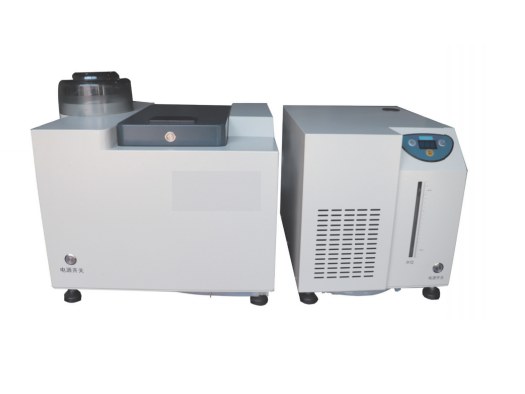
Overview
The RI-C5800 determines gross calorific value of coal, coke, oil, biomass, SRF, food and cement raw meal by the oxygen-bomb combustion method. Water quantity is metered automatically by a calibrated volumetric cup, the bomb is filled and lifted automatically, and a built-in refrigeration loop keeps the jacket at target temperature between runs.
A corrosion-resistant triple-thread oxygen bomb accepts biomass and high-ash samples, and the heat capacity drift stays within 0.20 % over a full year — the figure that decides whether your trade-lab results hold up in arbitration.
Key Features
Fully automatic water dosing
Volumetric-cup metering keeps inner-bucket water exactly constant run-to-run — the precondition for repeatable calorific values.
Corrosion-resistant oxygen bomb
Triple-thread bomb with anti-corrosion coating handles biomass, waste-derived fuels and chlorine-bearing samples without pitting.
Audit-ready software
Operator login levels, tamper-proof records, automatic raw-data backup and upload — ready for fuel-management and LIMS integration.
Single or dual control
Choose one or two thermostats on one controller. Dual-control doubles throughput for commercial labs with peak loads.
Technical Specifications
| Parameter | Declared value | Unit |
|---|---|---|
| Temperature range | 5 – 40 °C | °C |
| Temperature resolution | 0.0001 °C | °C |
| Precision (RSD) | ≤0.15 % | % |
| Test time | Classic ≤16 min · Fast ≤11 min | min |
| Heat capacity drift | ≤0.20 % within one year | % per year |
| Oxygen filling / lifting | Fully automatic | — |
| Water dosing | Calibrated volumetric cup | — |
| Power | <1 kW | kW |
| Dimensions (L×W×H) | 570×550×530 mm | mm |
| Weight | 68 kg | kg |
| Power supply | AC 220 V ±22 V, 50 Hz | — |
Download datasheet (PDF) or request a copy with your voltage & plug standard.
Standards: what each number covers
Buyers compare instruments by standard number, then have to look up the title and the relationship. This table does that for you. “Declared” means the method is named for this model; “equivalent” means the method is compatible in principle and must be verified against your own procedure; “referenced” means the standard supplies qualification or test conditions rather than the measurement itself. Final method compatibility depends on the configured instrument and your written test procedure.
| Standard | Title and relevance | Relationship |
|---|---|---|
| ISO 1928:2009 | Solid mineral fuels — Determination of gross calorific value by the bomb calorimetric method and calculation of net calorific valueInternational gross-calorific-value method; also defines the net-calorific-value calculation most power-plant contracts use. | Declared compliance |
| ASTM D5865-13 | Standard Test Method for Gross Calorific Value of Coal and CokeUS gross-calorific-value method — the most frequently named calorimeter standard in ASTM-referenced tenders. | Declared compliance |
| GB/T 213-2008 | Determination of calorific value of coal (GB/T series)Chinese national calorific-value method for coal. | Declared compliance |
| CEN/TS 14918 | Solid biofuels — Method for the determination of calorific value (CEN technical specification)European solid-biofuel calorific-value specification — relevant for biomass and SRF buyers. | Declared compliance |
| BS EN 15400 | Solid recovered fuels — Determination of calorific value (British/European standard)SRF calorific-value standard, typically named alongside CEN/TS 14918 in waste-derived-fuel projects. | Declared compliance |
| JJG 672-2018 | Verification regulation for oxygen bomb calorimeters (Chinese metrological verification regulation)Metrological verification regulation — the document a Chinese metrology institute cites when verifying or calibrating the calorimeter. | Declared compliance |
Listed applications
Frequently Asked Questions
What is the difference between isothermal and adiabatic bomb calorimeters?
An isothermal (static-jacket) calorimeter holds the water jacket at a near-constant temperature and corrects for the heat exchanged between bomb and jacket during the burn, using a pre-determined cooling constant. An adiabatic calorimeter actively heats the jacket so it tracks the bomb temperature, so there is no jacket-to-bomb heat leak to correct. Isothermal designs are simpler to maintain and easier to verify with a reference material; adiabatic designs need a jacket-control loop and a well-characterised adiabaticity. Under ISO 1928 or ASTM D5865, either design can be used — what matters is that the effective heat capacity, the jacket correction and the thermometer resolution are established and controlled in your own laboratory.
Do I need ISO 1928 and ASTM D5865 at the same time?
Only if you report to buyers who name different standards. Both define gross calorific value from a bomb-combustion measurement; the differences that matter in practice are the reference temperature, the treatment of the acid and fuse corrections, and the calculation basis for net calorific value. Decide which standard governs your reporting, then confirm the instrument configuration and the certification of the reference material against it — do not assume that a result obtained under one is automatically accepted under the other.
Why do two calorimeters give different calorific values for the same sample?
Most disagreements come from four places, not from the instrument: (1) sample preparation — moisture uptake or incomplete mixing of the analysis sample; (2) the heat-capacity determination, including whether it was done at the same temperature band as the test; (3) the fuse-wire and acid corrections, especially when the combustion is incomplete; and (4) the thermometer calibration traceability. A useful arbitration procedure is: run the same reference material on both units on the same day, then compare against the certified value before comparing samples with each other.
Which standards are declared for the RI-C5800, and are they equivalent or directly declared?
RI-C5800 is listed with: ISO 1928:2009 (declared compliance); ASTM D5865-13 (declared compliance); GB/T 213-2008 (declared compliance); CEN/TS 14918 (declared compliance); BS EN 15400 (declared compliance); JJG 672-2018 (declared compliance). The standards table below shows what each number covers. Final method compatibility depends on the configured instrument and the customer's written test procedure.
Which samples can the RI-C5800 be used for?
Listed applications: Coal trading & pricing, Power plants, Biomass & SRF fuel, Petroleum products, Food calorimetry, Cement raw meal. Send the sample matrix, preparation method and reporting standard so the configuration and the acceptance criteria can be confirmed in writing.
How do I get a quotation and the datasheet for the RI-C5800?
Send the sample type, daily throughput, required standard, destination country, voltage and plug standard, and any prequalification documents your buyer requires. RoyIntelli will confirm the configuration, the documents available for that model and the commercial terms in a written quotation. Final specifications, lead time, warranty and payment terms are confirmed in the Proforma Invoice.