
Automatic Proximate Analyzer (TGA)
Fully automatic thermogravimetric analyzer for moisture, ash, volatile matter and fixed carbon — 20 samples in 90–120 minutes, unattended.
- 20 samples × 3 parameters in 90–120 min
- Dual-furnace parallel operation, fully unattended
- 0.1 mg weighing resolution, ±1 °C temperature control
- Complies with ASTM D7582 & GB/T 212
Overview
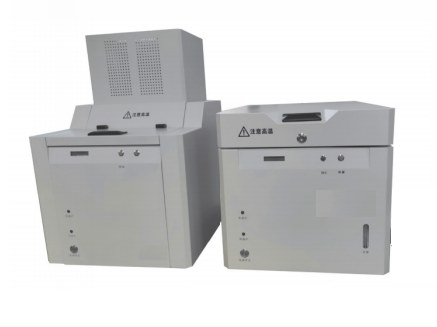
The RI-MAC67 Automatic Proximate Analyzer determines moisture, ash and volatile matter in coal, coke, biomass and solid waste using the thermogravimetric (TGA) method. Two furnaces work in parallel (or independently) so moisture, ash and volatile matter are measured simultaneously — load 20 crucibles once and walk away: no crucible swapping, no lid handling, no operator attendance required.
A round-well high-temperature furnace keeps temperature distribution uniform, while the built-in thermobalance with blank-crucible dynamic calibration guarantees weighing accuracy run after run. The classic slow-ash mode follows the ≤500 °C / ≥30 min requirement used for referee-grade results.
Key Features
Dual furnace, zero idle time
Two host units run batches in alternation — 20 more samples are already heating while the previous batch is being weighed. An 8-hour shift completes 4 full batches.
True thermobalance accuracy
Samples never travel between furnace and balance. Dynamic blank-crucible correction in the same atmosphere eliminates the drift that plagues conveyor-type designs.
Silent air pump, no gas cylinders
Built-in quiet air pump means no oxygen or nitrogen supply is required for routine proximate analysis — safer labs, lower running cost.
Imported components throughout
Imported precision balance, monolithic heating furnace chamber, ceramic turntable/shaft/pusher rods and linear rails for years of stable 24/7 operation.
Technical Specifications
| Parameter | Declared value | Unit |
|---|---|---|
| Test time | 90–120 min for 20 samples (M, A, V) | min for 20 samples |
| Samples per run | 20 | samples |
| Temperature range | Ambient – 1050 °C | °C |
| Temperature control accuracy | ±1 °C | °C |
| Temperature resolution | 0.1 °C | °C |
| Weighing resolution | 0.0001 g | g |
| Precision | Conforms to GB/T 212-2008 & ASTM D5142 | declared method basis |
| Power | Unit I ≤4 kW · Unit II ≤5 kW | kW |
| Dimensions (W×D×H) | 580×580×870 mm + 580×580×530 mm | mm |
| Weight | 60 kg + 55 kg | kg |
Download datasheet (PDF) or request a copy with your voltage & plug standard.
Standards: what each number covers
Buyers compare instruments by standard number, then have to look up the title and the relationship. This table does that for you. “Declared” means the method is named for this model; “equivalent” means the method is compatible in principle and must be verified against your own procedure; “referenced” means the standard supplies qualification or test conditions rather than the measurement itself. Final method compatibility depends on the configured instrument and your written test procedure.
| Standard | Title and relevance | Relationship |
|---|---|---|
| ASTM D7582 | Standard Test Methods for Proximate Analysis of Coal and Coke by Macro Thermogravimetric AnalysisMacro-TGA proximate analysis (moisture, ash, volatile matter) — the method the analyzer's dual-furnace workflow is designed around. | Declared compliance |
| ASTM D5142 | Standard Test Methods for Proximate Analysis of the Analysis Sample of Coal and Coke by Instrumental ProceduresInstrumental-procedures proximate analysis — the ASTM counterpart to the TGA workflow. | Declared compliance |
| GB/T 212-2008 | Proximate analysis of coal (Chinese national standard, GB/T series)Chinese national proximate-analysis method; widely cited in Chinese-sourced tenders and often used alongside ASTM D7582 for cross-checking. | Declared compliance |
| GB/T 211-2007 | Determination of total moisture in coal (GB/T series)Total-moisture determination method used when the laboratory reports as-received or total moisture. | Declared compliance |
| GB/T 30729-2014 | Determination of total sulfur in solid biomass fuels (GB/T series)Biomass total-sulfur method; relevant when the same lab tests biomass or co-fired fuels. | Declared compliance |
| YS/T 587 | Methods for proximate analysis of carbon materials (non-ferrous metallurgy industry standard)Industry method for carbon materials (e.g. anode/coke-type samples) — matters for aluminium and carbon-plant laboratories. | Declared compliance |
| HJ 1024-2019 | Determination of total sulfur in solid waste — high-temperature combustion / IR or coulometric method (environmental industry standard)Solid-waste sulfur method — relevant for waste-to-energy and environmental monitoring laboratories. | Declared compliance |
Listed applications
Frequently Asked Questions
Is a TGA proximate analyzer the same as a thermogravimetric analyzer used in materials science?
The measuring principle is the same — mass change versus temperature — but a coal proximate analyzer is built around a fixed regulatory sequence: moisture at the specified drying temperature and time, volatile matter in a covered crucible at the specified temperature and duration, and ash at the ashing temperature until constant mass. The result is reported as M, A, V and fixed carbon by difference. A general-purpose laboratory TGA usually has a much wider temperature range and a different crucible and atmosphere regime, so its data are not automatically reportable as proximate analysis.
What decides the volatile matter result in a TGA analyzer?
Four variables dominate: the crucible lid (a covered crucible is required by the method to stop oxidation of the char), the furnace temperature and its uniformity at the measuring position, the residence time, and the sample mass. On a conveyor-type design the sample travels between furnace and balance; on a design where the crucible stays on the balance inside the furnace, the weighing path is not disturbed. Whatever the design, blank-crucible correction and a temperature profile check should be part of your acceptance procedure.
Can one proximate analyzer replace a muffle furnace and a moisture oven?
For routine proximate analysis, yes — moisture, ash and volatile matter can be produced in one instrument in one run. A separate muffle furnace is still needed for ash-fusion sample preparation, ignition-loss work, and any procedure that requires a specific furnace programme or larger chamber. Many laboratories keep both, using the muffle furnace for method development and referee work.
Which standards are declared for the RI-MAC67, and are they equivalent or directly declared?
RI-MAC67 is listed with: ASTM D7582 (declared compliance); ASTM D5142 (declared compliance); GB/T 212-2008 (declared compliance); GB/T 211-2007 (declared compliance); GB/T 30729-2014 (declared compliance); YS/T 587 (declared compliance); HJ 1024-2019 (declared compliance). The standards table below shows what each number covers. Final method compatibility depends on the configured instrument and the customer's written test procedure.
Which samples can the RI-MAC67 be used for?
Listed applications: Coal & coke trade, Power plants, Commercial labs, Biomass & SRF, Cement (LOI), Iron ore (LOI). Send the sample matrix, preparation method and reporting standard so the configuration and the acceptance criteria can be confirmed in writing.
How do I get a quotation and the datasheet for the RI-MAC67?
Send the sample type, daily throughput, required standard, destination country, voltage and plug standard, and any prequalification documents your buyer requires. RoyIntelli will confirm the configuration, the documents available for that model and the commercial terms in a written quotation. Final specifications, lead time, warranty and payment terms are confirmed in the Proforma Invoice.