
Robotic Coulometric Sulfur Analyzer
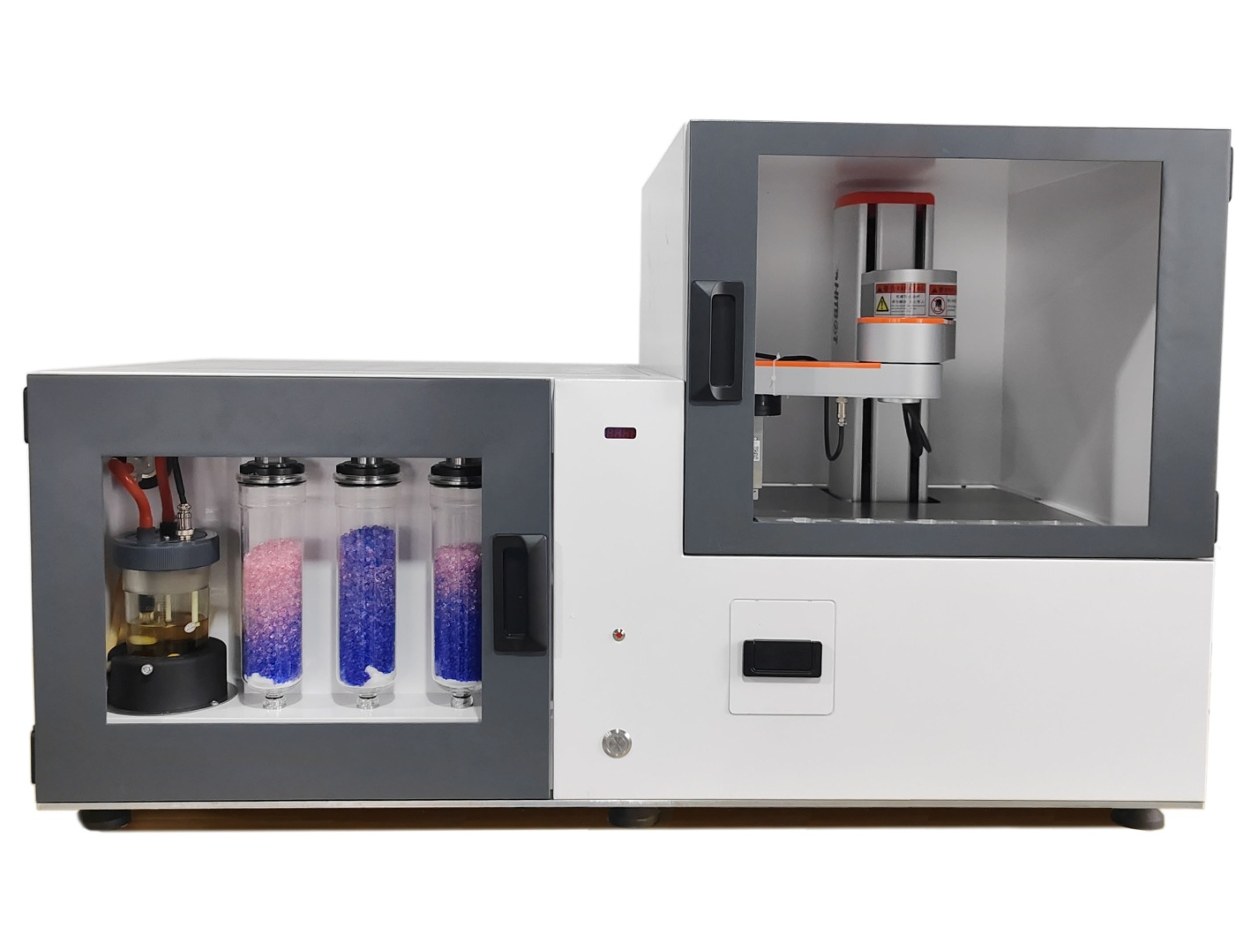
Robot-arm coulometric sulfur analyzer — 25 samples with unlimited top-up, automatic WO₃ dosing, true walk-away operation.
- Robotic gripper — no dropped or stuck samples
- 25 samples initially, unlimited top-up mid-run
- Automatic, uniform WO₃ catalyst dosing
- Real-time digital gas flow display
Overview
The RI-DFS220 takes coulometric sulfur analysis to full automation: a precision robotic gripper loads, runs, ejects and discards boats continuously. Start with 25 samples and keep adding during the run — the robot integrates newcomers into the queue without interrupting electrolysis.
It also meters tungsten trioxide catalyst automatically and evenly, displays gas flow on a digital flowmeter in real time, and exposes an open database so third-party LIMS can pull results the moment they are calculated.
Key Features
True unattended operation
Automatic sample feeding, testing, ejection and disposal. Overnight batches finish and report themselves.
Automatic catalyst dosing
Quantitative WO₃ addition, spread evenly over the boat — the detail that decides combustion completeness for high-ash coal.
Open database integration
Results can be mirrored to your LIMS in real time; raw curves are retained for audit.
DSP + hardware integration
Dedicated DSP controller and hardware integrating circuit give deterministic endpoint detection with field-upgradable firmware.
Technical Specifications
| Parameter | Declared value | Unit |
|---|---|---|
| Samples per run | 25, unlimited top-up | samples |
| Sulfur range | 0.01 % – 40 % | % |
| Resolution | 0.001 % | % |
| Sample mass | 45–55 mg (coal) · 80–100 mg (oil) | mg |
| Test time per sample | 3–5 min | min |
| Furnace temperature | 1150 °C (coal/coke) · 920 °C (oil) | °C |
| Temperature control accuracy | ±1 °C | °C |
| Power | <3 kW | kW |
| Dimensions (L×W×H) | 1100×550×675 mm | mm |
| Weight | 60 kg | kg |
Download datasheet (PDF) or request a copy with your voltage & plug standard.
Standards: what each number covers
Buyers compare instruments by standard number, then have to look up the title and the relationship. This table does that for you. “Declared” means the method is named for this model; “equivalent” means the method is compatible in principle and must be verified against your own procedure; “referenced” means the standard supplies qualification or test conditions rather than the measurement itself. Final method compatibility depends on the configured instrument and your written test procedure.
| Standard | Title and relevance | Relationship |
|---|---|---|
| GB/T 214-2007 | Determination of total sulfur in coal (GB/T series)Chinese national total-sulfur method for coal; the reference method behind the coulometric and robotic sulfur analyzers. | Declared compliance |
| GB/T 28732-2012 | Determination of total sulfur in solid biomass fuels (GB/T series)Biomass total-sulfur method supported by the same sulfur analyzers. | Declared compliance |
| ISO 16994:2015 | Solid biofuels — Determination of total content of sulfur and chlorineInternational solid-biofuel sulfur method; the ISO counterpart to GB/T 28732. | Declared compliance |
Listed applications
Frequently Asked Questions
When is a robotic sulfur analyzer worth the extra cost over a manual one?
The economics turn on operator hours rather than on measurement speed: a robotic unit loads crucibles into a queue and runs unattended, so one analyst can cover sulfur, calorific value and proximate work in parallel. It pays when daily sulfur throughput exceeds what one operator can feed by hand across a shift, or when you need results overnight. If you run a few dozen determinations a day, a manual coulometric analyzer is usually the better fit.
Does robotic loading change the analytical result?
The chemistry does not change — the same combustion and coulometric determination is used. What changes is consistency: sample mass recording, crucible handling and insertion timing are performed the same way for every sample, which removes a common source of operator-to-operator variability. It does not remove the need for reference-material checks, and it does not make a badly prepared sample good.
Which standards are declared for the RI-DFS220, and are they equivalent or directly declared?
RI-DFS220 is listed with: GB/T 214-2007 (declared compliance); GB/T 28732-2012 (declared compliance); ISO 16994:2015 (declared compliance). The standards table below shows what each number covers. Final method compatibility depends on the configured instrument and the customer's written test procedure.
Which samples can the RI-DFS220 be used for?
Listed applications: Commercial testing labs, Mine mouth labs, Power plant fuel yards, Biomass terminals. Send the sample matrix, preparation method and reporting standard so the configuration and the acceptance criteria can be confirmed in writing.
How do I get a quotation and the datasheet for the RI-DFS220?
Send the sample type, daily throughput, required standard, destination country, voltage and plug standard, and any prequalification documents your buyer requires. RoyIntelli will confirm the configuration, the documents available for that model and the commercial terms in a written quotation. Final specifications, lead time, warranty and payment terms are confirmed in the Proforma Invoice.