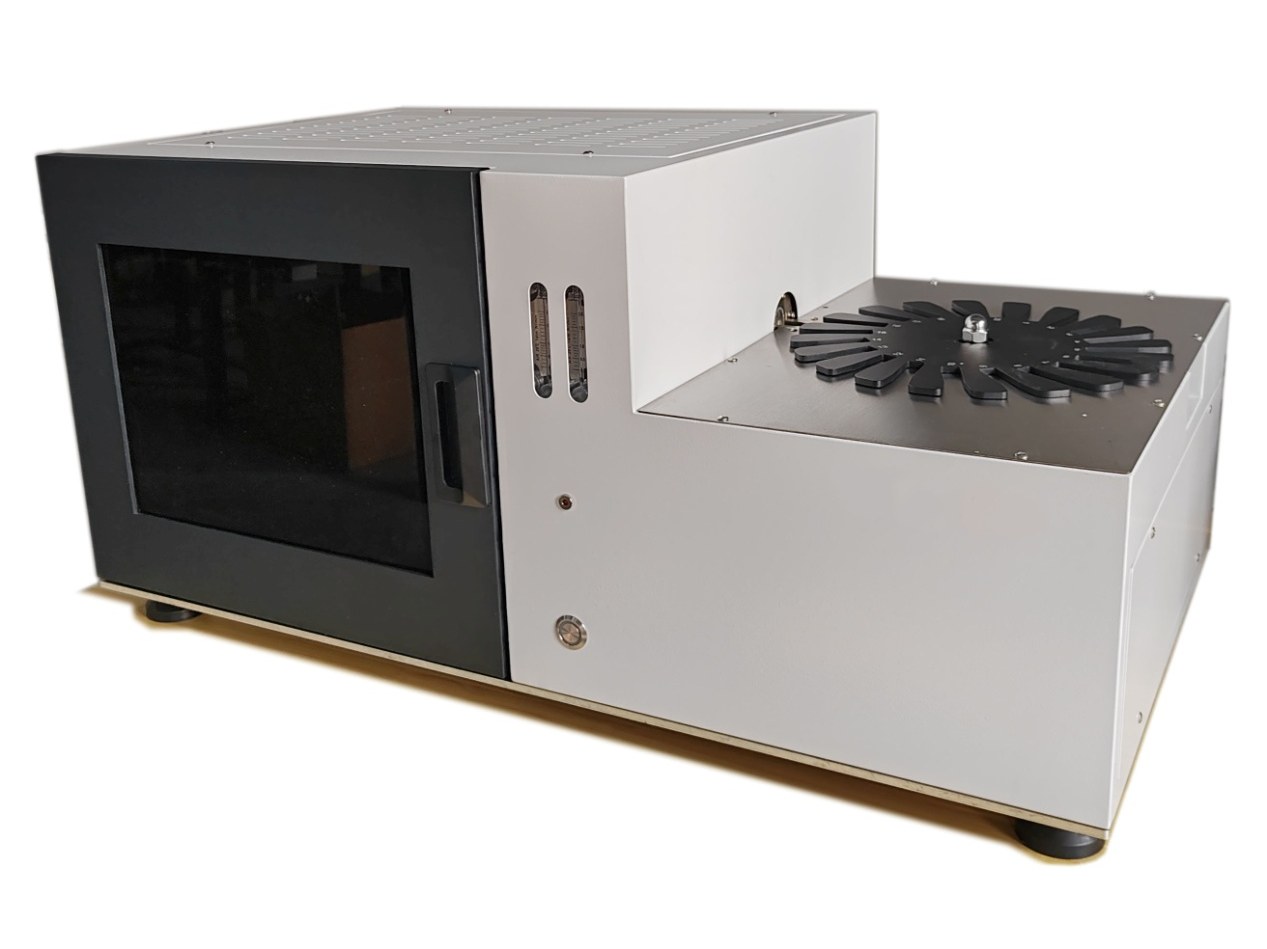
Automatic Horizontal Coulometric Sulfur Analyzer
Coulometric titration total-sulfur analyzer, 20-position autosampler, 3–5 min per sample, range 0.01–40 %.
- 20 samples unattended, 3–5 min per sample
- Wide range 0.01 %–40 %, resolution 0.001 %
- 1150 °C for coal/coke, 920 °C for oil
- Open database for LIMS integration
Overview
The RI-S320 measures total sulfur in coal, coke, oil and solid biomass by coulometric titration — the classical reference method used in trade settlement. Load up to 20 samples (or run single samples), and the analyzer handles delivery, electrolysis, endpoint detection and reporting automatically.
A horizontal imported-material furnace with national-standard ceramic boats guarantees complete combustion, while the large-electrode electrolysis cell delivers repeatable results even at low sulfur levels. DSP control with hardware integration keeps real-time response and allows easy software upgrades.
Key Features
Multi-damping sample pusher
Shock-absorbing delivery mechanism feeds boats smoothly — no dropped or jammed boats, even during long overnight batches.
Large-electrode electrolysis cell
Bigger platinum electrodes improve charge efficiency and repeatability, especially on low-sulfur coal between 0.01 % and 1 %.
Self-diagnostics at boot
The instrument checks itself at power-on, displays fault codes and maintenance suggestions to keep downtime short.
Easy electrolyte service
Drain valve for quick cell rinsing plus an oversized drying tube cut consumable changes to minutes per week.
Technical Specifications
| Parameter | Declared value | Unit |
|---|---|---|
| Samples per run | 20 (or single sample) | samples |
| Sulfur range | 0.01 % – 40 % | % |
| Resolution | 0.001 % | % |
| Sample mass | 45–55 mg (coal) · 80–100 mg (oil) | mg |
| Test time per sample | 3–5 min | min |
| Furnace temperature | 1150 °C (coal/coke) · 920 °C (oil) | °C |
| Temperature control accuracy | ±1 °C | °C |
| Power | <3 kW | kW |
| Dimensions (L×W×H) | 988×520×375 mm | mm |
| Weight | 45 kg | kg |
Download datasheet (PDF) or request a copy with your voltage & plug standard.
Standards: what each number covers
Buyers compare instruments by standard number, then have to look up the title and the relationship. This table does that for you. “Declared” means the method is named for this model; “equivalent” means the method is compatible in principle and must be verified against your own procedure; “referenced” means the standard supplies qualification or test conditions rather than the measurement itself. Final method compatibility depends on the configured instrument and your written test procedure.
| Standard | Title and relevance | Relationship |
|---|---|---|
| GB/T 214-2007 | Determination of total sulfur in coal (GB/T series)Chinese national total-sulfur method for coal; the reference method behind the coulometric and robotic sulfur analyzers. | Declared compliance |
| GB/T 28732-2012 | Determination of total sulfur in solid biomass fuels (GB/T series)Biomass total-sulfur method supported by the same sulfur analyzers. | Declared compliance |
| ISO 16994:2015 | Solid biofuels — Determination of total content of sulfur and chlorineInternational solid-biofuel sulfur method; the ISO counterpart to GB/T 28732. | Declared compliance |
Listed applications
Frequently Asked Questions
Coulometric or infrared sulfur analysis — which should my laboratory use?
Coulometric determination measures the charge needed to titrate the SO2 absorbed in an electrolyte, so it is essentially absolute and needs no calibration curve; it is strong for low-sulfur samples and for methods that name it explicitly. Infrared absorption measures SO2 by its absorption bands and needs calibration against reference materials, but is fast and has a wide linear range. The deciding questions are: which method is named in the standard you must report to, what sulfur range dominates your samples, and whether you can maintain electrolyte/calibration logistics in your laboratory.
Why does the electrolyte need replacing, and how often?
The electrolyte is consumed and contaminated during each determination: the iodide/tri-iodide couple is depleted and combustion residues accumulate. Replacement frequency depends on sample count, sulfur content, and the purity of the oxygen and carrier gas — it is a laboratory-established interval based on end-point stability checks, not a fixed calendar period. Track it with a daily reference-material check so an electrolyte failure is caught before it produces a wrong result.
What sulfur range can a coulometric analyzer report?
The declared range for the RI-S320 and RI-DFS220 is 0.01 % to 40 % total sulfur, with 0.001 % resolution. Outside that band — very low sulfur near the detection limit, or high-sulfur samples near the upper limit — confirm the sample mass, the combustion condition and the end-point behaviour with an engineer, because both ends need a different test strategy.
Which standards are declared for the RI-S320, and are they equivalent or directly declared?
RI-S320 is listed with: GB/T 214-2007 (declared compliance); GB/T 28732-2012 (declared compliance); ISO 16994:2015 (declared compliance). The standards table below shows what each number covers. Final method compatibility depends on the configured instrument and the customer's written test procedure.
Which samples can the RI-S320 be used for?
Listed applications: Coal & coke labs, Power plants, Solid biomass fuel, Petroleum products. Send the sample matrix, preparation method and reporting standard so the configuration and the acceptance criteria can be confirmed in writing.
How do I get a quotation and the datasheet for the RI-S320?
Send the sample type, daily throughput, required standard, destination country, voltage and plug standard, and any prequalification documents your buyer requires. RoyIntelli will confirm the configuration, the documents available for that model and the commercial terms in a written quotation. Final specifications, lead time, warranty and payment terms are confirmed in the Proforma Invoice.