
Ash Fusion Determinator (AFDT)
Automatic ash fusion determinator with CCD image recognition — DT/ST/HT/FT to 1600 °C, ±1 °C, video replay of every run.
- True 1600 °C max temperature, ±1 °C accuracy
- Automatic DT/ST/HT/FT recognition + video replay
- Sealed one-piece furnace tube — ~1 g carbon per run
- Manual viewing port alongside camera for arbitration
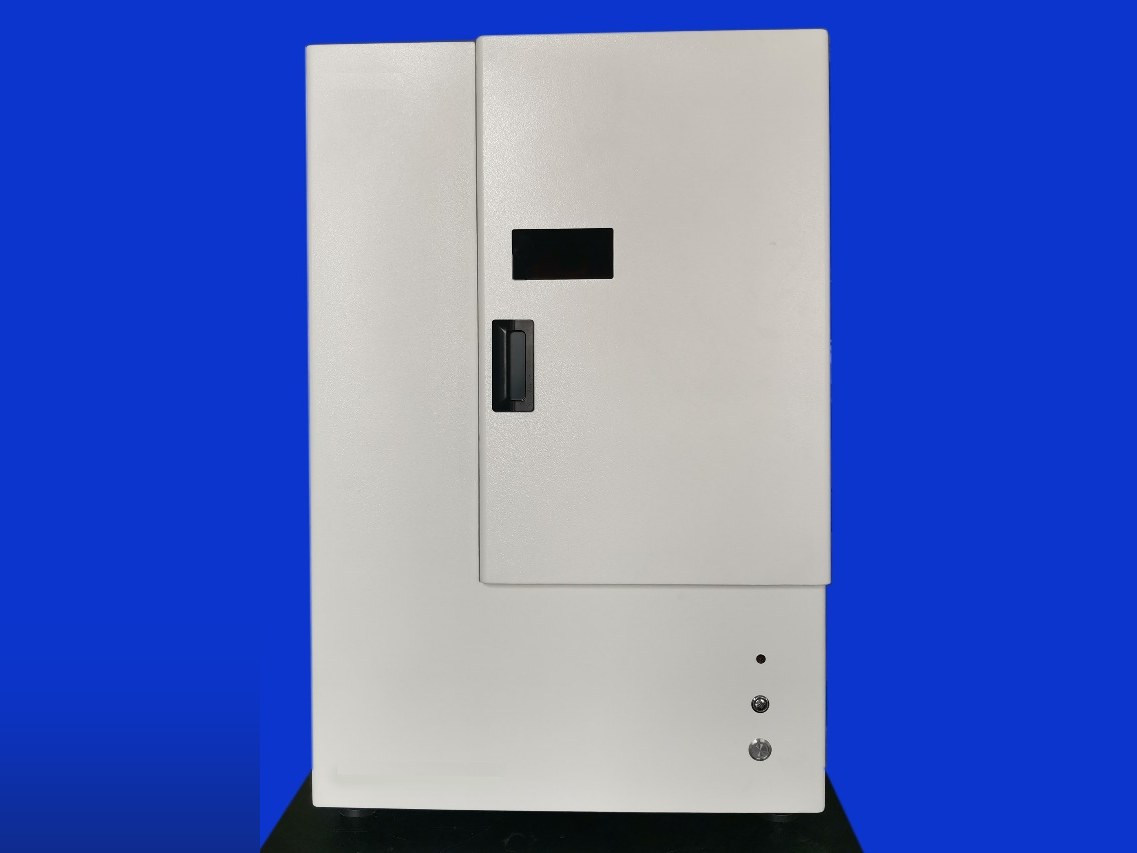
Overview
The RI-AF1600 heats ash cones to 1600 °C and identifies the four characteristic temperatures — deformation (DT), softening (ST), hemisphere (HT) and flow (FT) — automatically, using an imported CCD camera with auto-iris lens and intelligent image recognition.
A type-B thermocouple is built into the cone plate so the measured temperature tracks the true cone temperature. The furnace uses a one-piece molded tube with double sealing: about 1 g of activated carbon is enough to establish a weak-reducing atmosphere. X+Z dual-axis stage brings samples to the operator so cones never topple in transit.
Key Features
Replayable evidence
Images saved at user-defined intervals let you replay the whole run and manually re-verify any automatically judged temperature.
Camera-friendly thermal design
Image reflection optics and an independent camera cooling jacket shield the CCD from radiation — longer camera life.
Two-minute refocus
Front camera with six-degree micro focus: after the first setup, one person refocuses in under 2 minutes.
MoSi₂ elements to 1500 °C+
T1700-grade molybdenum disilicide heating elements with dedicated clamps run above 1500 °C continuously.
Technical Specifications
| Parameter | Declared value | Unit |
|---|---|---|
| Method | Oxidizing / weak-reducing atmosphere (carbon seal or gas) | — |
| Max working temperature | 1600 °C | °C |
| Temperature accuracy | ±1 °C | °C |
| Heating rate | Below 900 °C: 15–30 °C/min; above: 5–10 °C/min (settable) | °C/min |
| Image storage interval | 1 frame / 2 °C (settable) | frame per °C |
| Samples per run | 1 – 5 | samples |
| Accuracy | T1 ≤40 °C · T2–T4 ≤30 °C | °C (T1 / T2–T4) |
| Power | ≤5 kW | kW |
| Dimensions (L×W×H) | 660×530×1050 mm | mm |
| Weight | 120 kg | kg |
Download datasheet (PDF) or request a copy with your voltage & plug standard.
Standards: what each number covers
Buyers compare instruments by standard number, then have to look up the title and the relationship. This table does that for you. “Declared” means the method is named for this model; “equivalent” means the method is compatible in principle and must be verified against your own procedure; “referenced” means the standard supplies qualification or test conditions rather than the measurement itself. Final method compatibility depends on the configured instrument and your written test procedure.
| Standard | Title and relevance | Relationship |
|---|---|---|
| GB/T 219-2008 | Determination of fusibility of coal ash (GB/T series)Chinese national ash-fusion method (DT/ST/HT/FT). | Declared compliance |
| ISO 540 (equivalent method) | Hard coal and coke — Determination of ash fusibilityListed as an equivalent method; testing atmosphere (oxidising or reducing) changes the reported temperatures and must be fixed in the test procedure. | Equivalent method |
Listed applications
Frequently Asked Questions
What is the difference between DT, ST, HT and FT?
They are the four characteristic temperatures of a shrinking ash cone as it is heated: deformation temperature (DT) when the cone first rounds, sphere temperature (ST) when it becomes a sphere, hemisphere temperature (HT) when it becomes a hemisphere, and flow temperature (FT) when it spreads. They are read against the same image sequence, so the atmosphere, the heating rate and the image review criteria must be fixed before the test — changing any of them shifts all four temperatures.
Oxidising or reducing atmosphere — which one applies?
It depends on the standard and on the combustion environment you are trying to represent. Oxidising conditions are typical for the reference method's default run; weak-reducing conditions (carbon seal or a controlled gas mixture) are used to simulate the reducing zone close to a burner. Because the same coal can fuse at materially different temperatures in the two atmospheres, the atmosphere must be stated with every reported value.
Which standards are declared for the RI-AF1600, and are they equivalent or directly declared?
RI-AF1600 is listed with: GB/T 219-2008 (declared compliance); ISO 540 (equivalent method) (equivalent method). The standards table below shows what each number covers. Final method compatibility depends on the configured instrument and the customer's written test procedure.
Which samples can the RI-AF1600 be used for?
Listed applications: Boiler design & slagging assessment, Gasifier feed evaluation, Coal trade arbitration, Biomass ash behavior. Send the sample matrix, preparation method and reporting standard so the configuration and the acceptance criteria can be confirmed in writing.
How do I get a quotation and the datasheet for the RI-AF1600?
Send the sample type, daily throughput, required standard, destination country, voltage and plug standard, and any prequalification documents your buyer requires. RoyIntelli will confirm the configuration, the documents available for that model and the commercial terms in a written quotation. Final specifications, lead time, warranty and payment terms are confirmed in the Proforma Invoice.